PFMini: 300W Wide-Input Buck-Boost DC-DC Converter
9–53 V input · 5–27.6 V adjustable output · 12.5 A · 300 W
Regulated output from 12 V, 24 V, 28 V, 36 V and 48 V DC systems.
A powerful DC voltage-regulating tool with impressive throughput in a small package: 12.5 A or 300 W, whichever comes first.
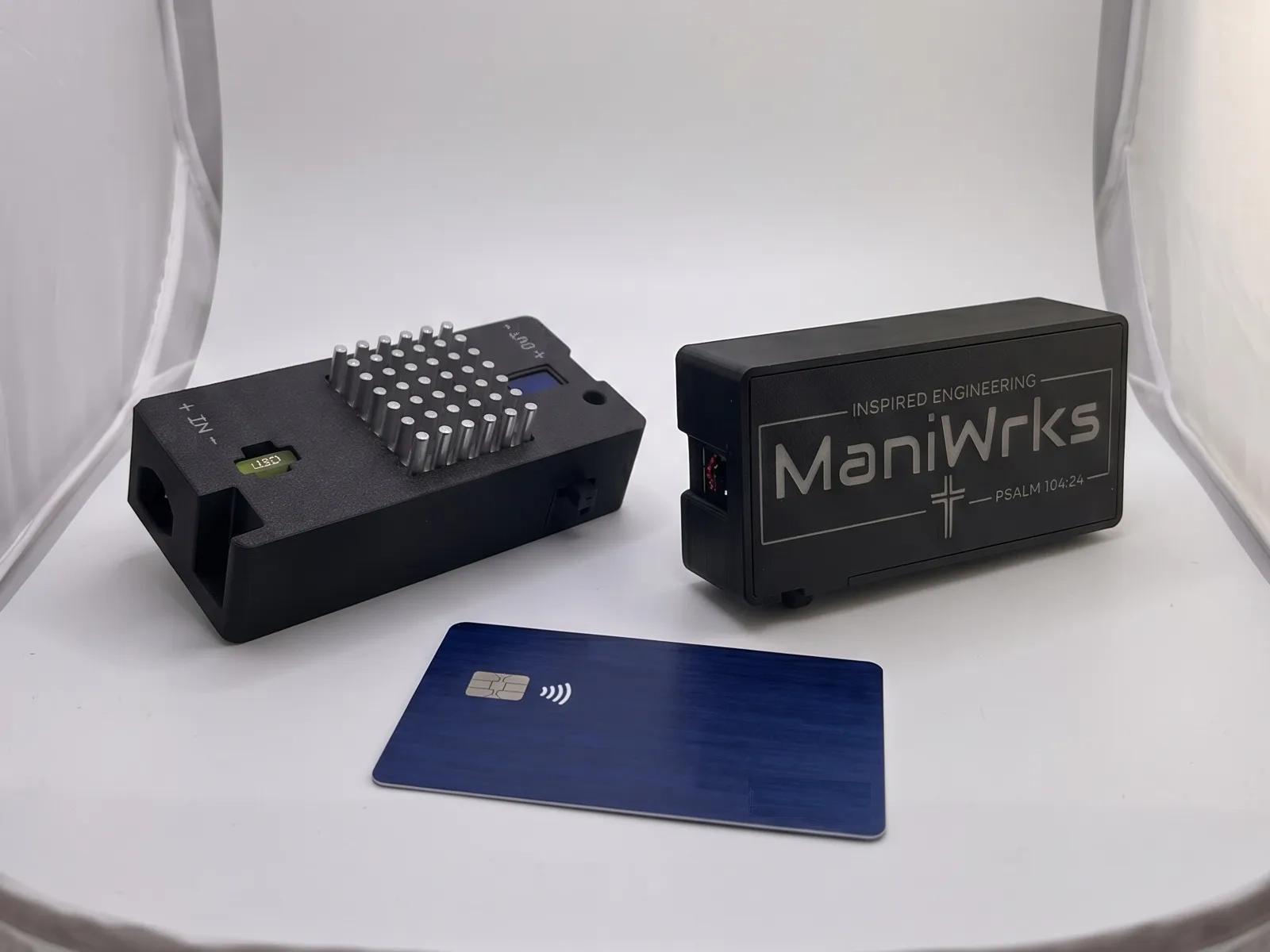
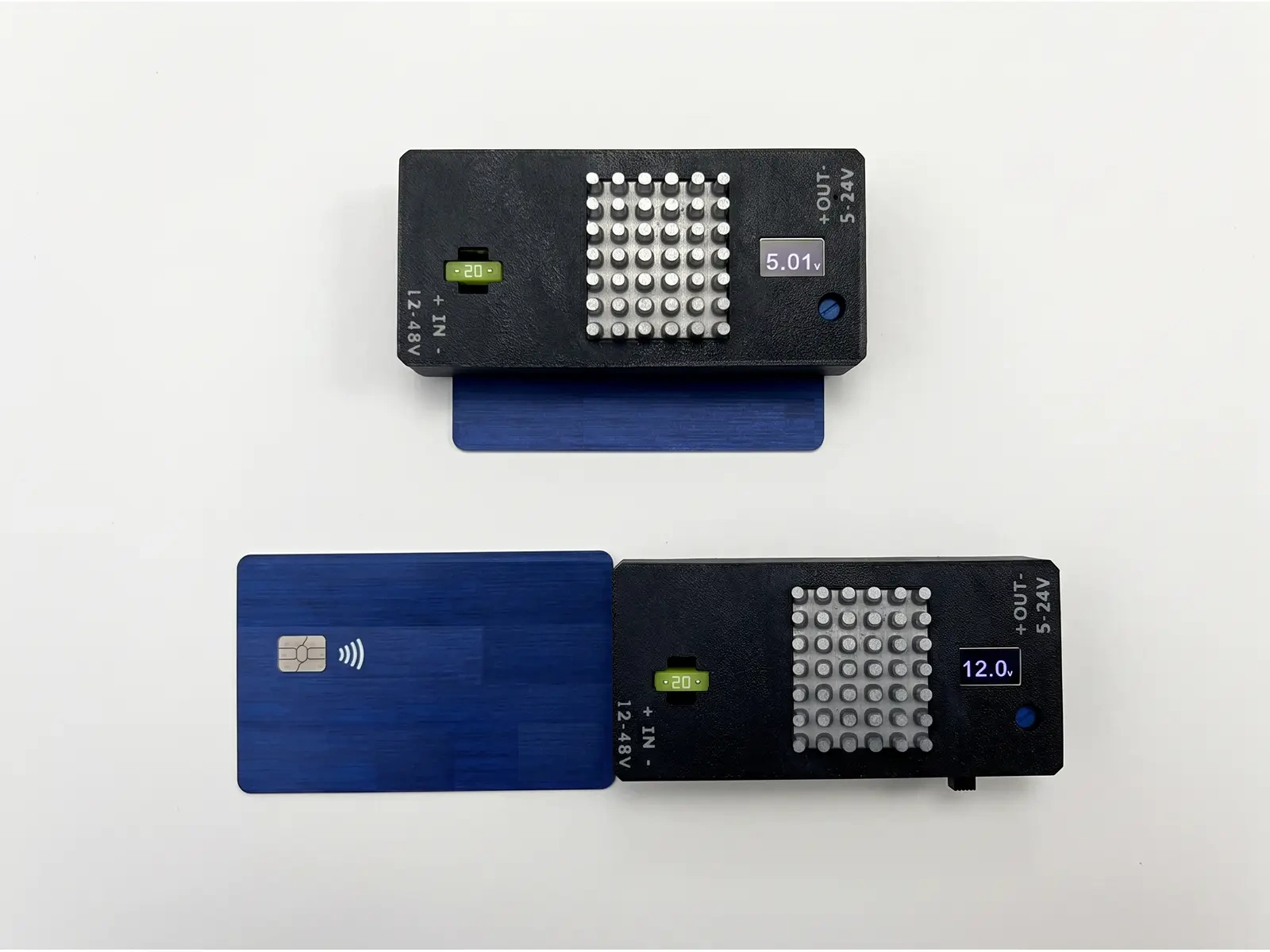
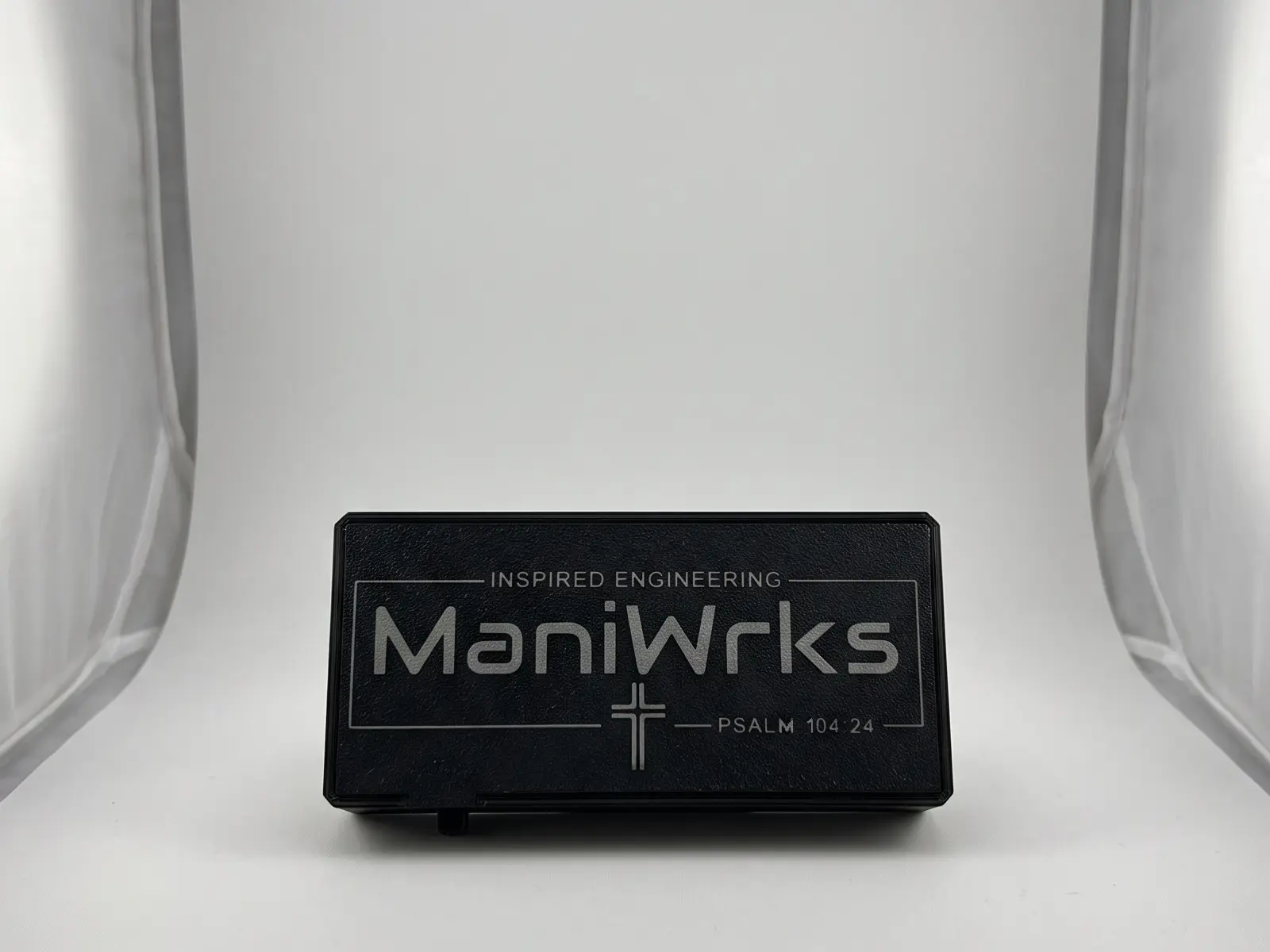
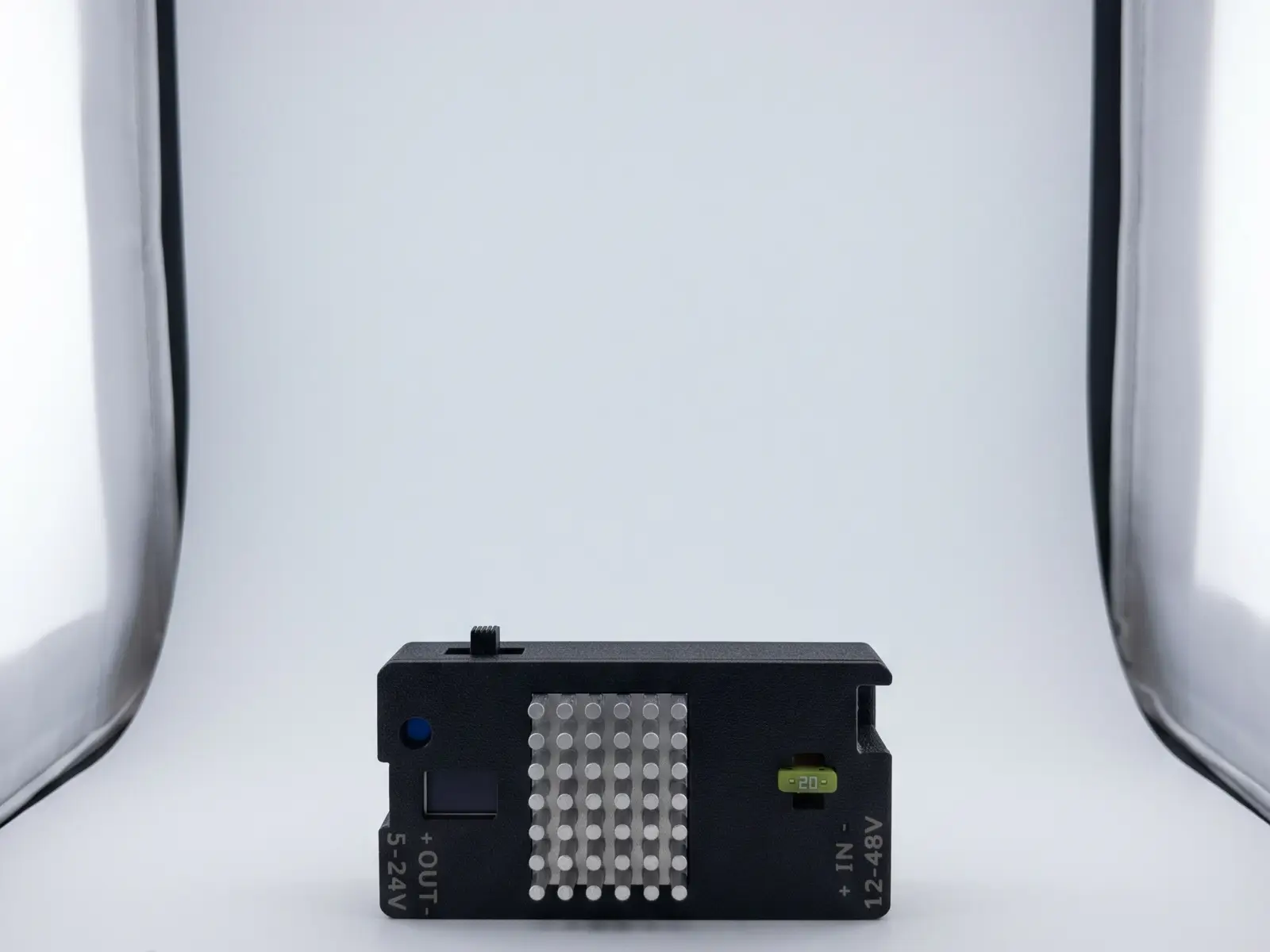
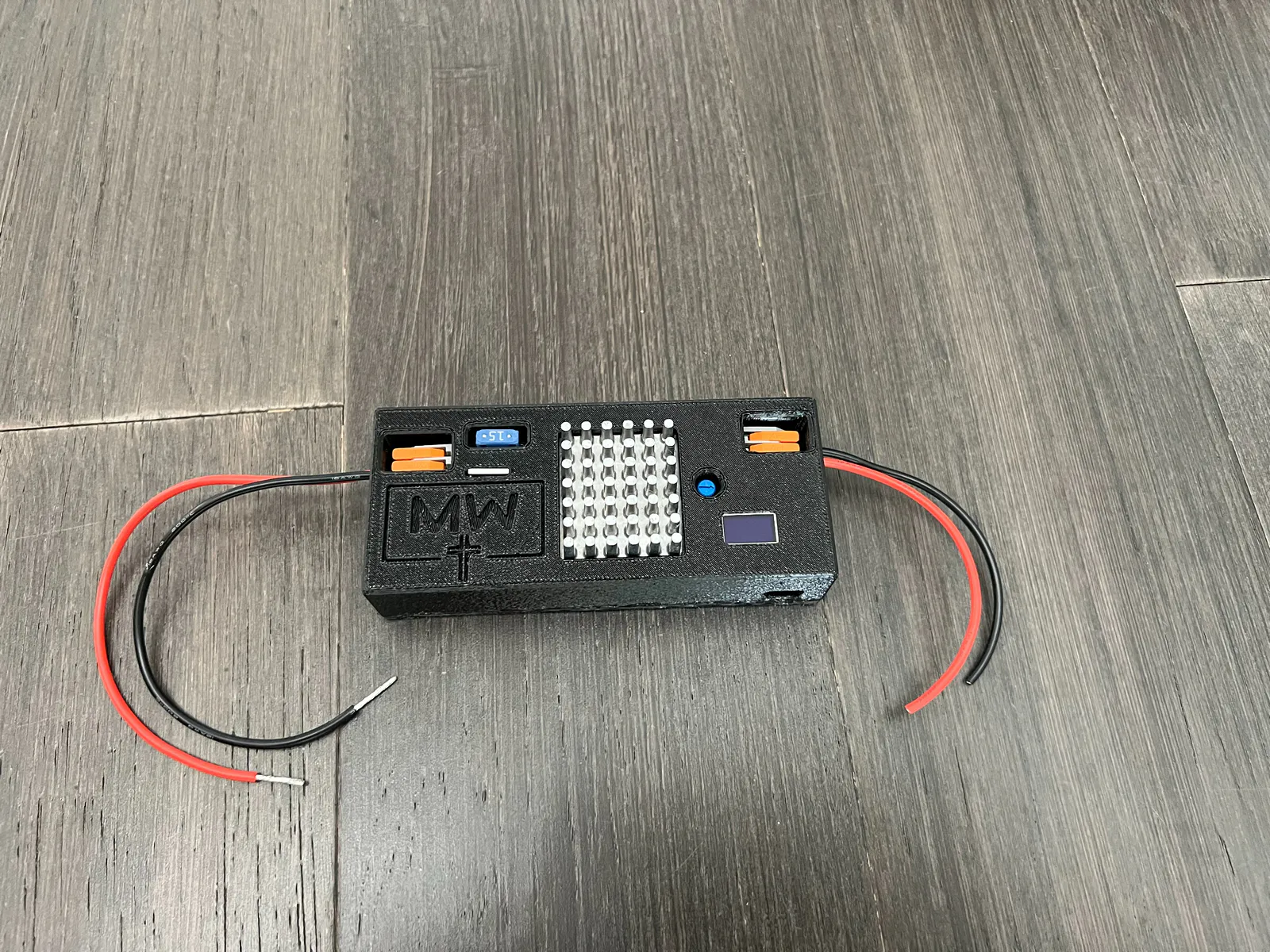
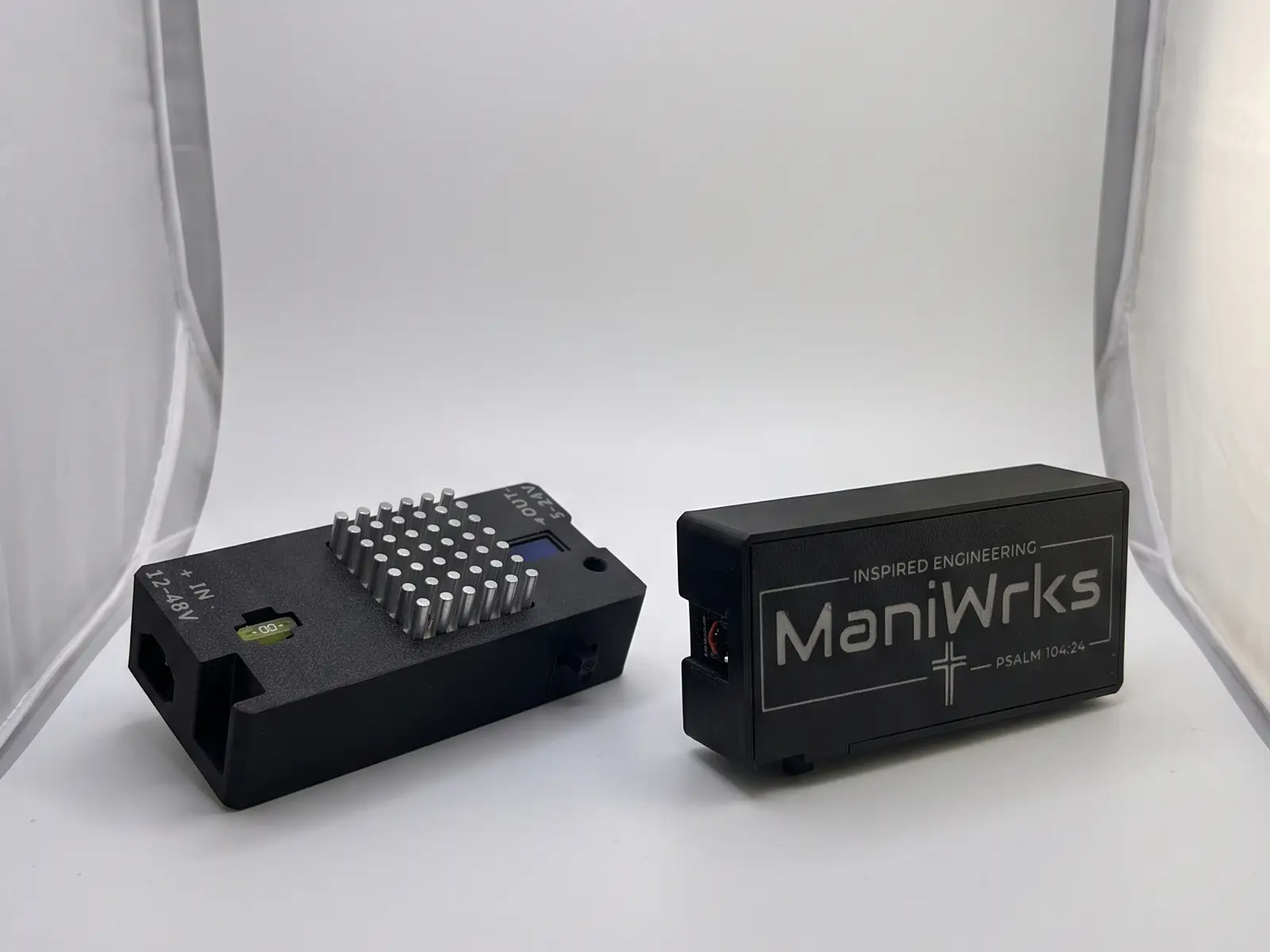
The PFMini is a compact buck-boost converter that holds a set output voltage whether the input is above, below or equal to it. Pick a range with the 3-position switch, set the voltage with the trim control, and read it on the built-in OLED voltmeter. The input is protected against reversed wiring, overcurrent and large voltage spikes. A fan cools the input stage, and the converter's heatsink fins sit outside the enclosure in open air.
$299.00 USD Plus applicable tax, shipping and handling. Taking orders now!
Why it exists
Bare converter boards are cheap, but their ratings are rarely sustained in practice and most have no input protection. Branded vehicle converters are well built, but most have fixed or narrow output ranges aimed at one job. The PFMini covers the space between: a wide 9–53 V input, a buck-boost converter that can step up or down, a 5 V fixed or 6.1–27.6 V adjustable output at up to 12.5 A, input protection, and a built-in voltmeter, in an enclosure about 96 mm long.
What it is
Complete out of the box.
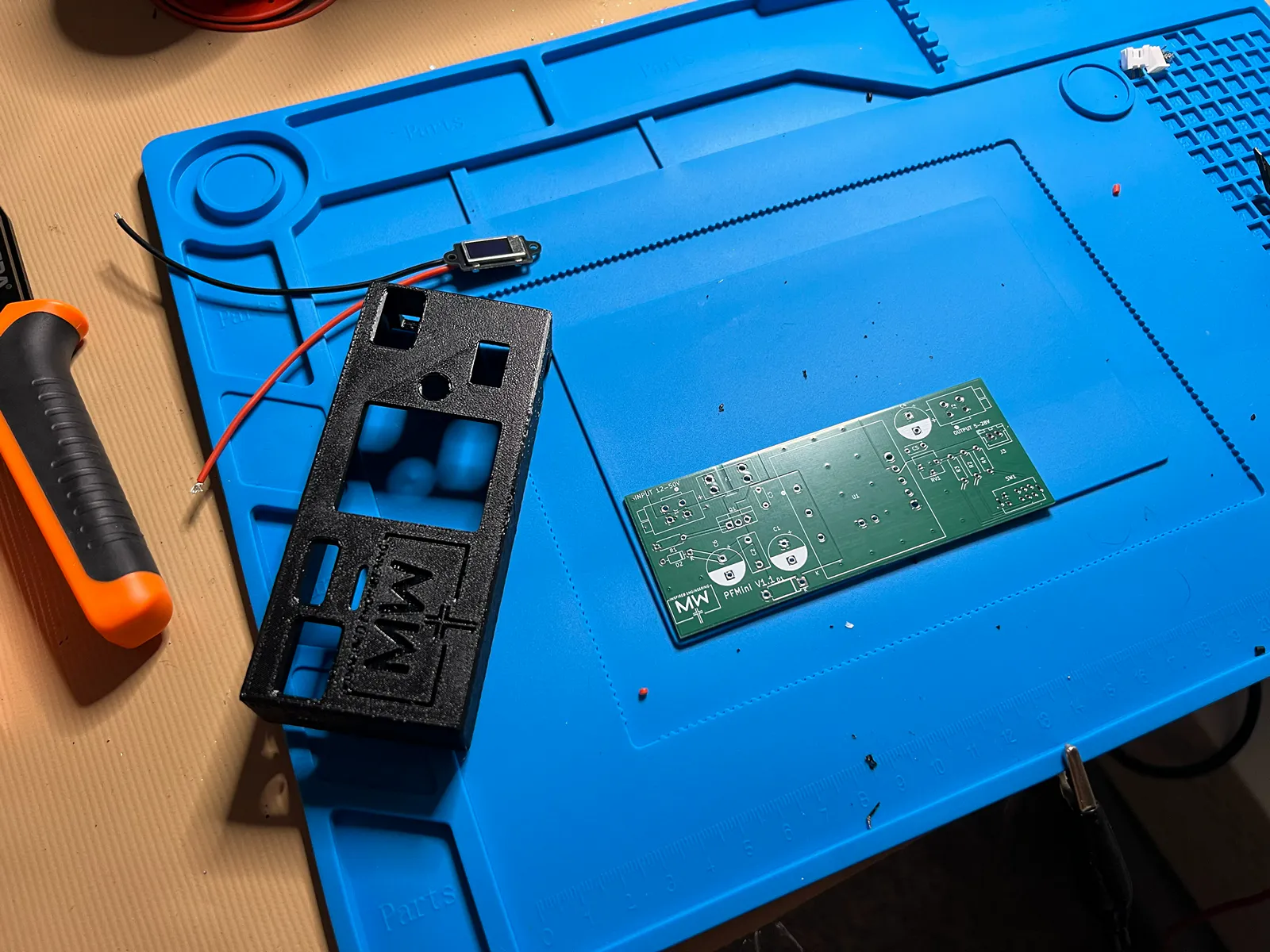
Input protection, a replaceable fuse, input and output terminals, fan cooling and an OLED voltmeter are built in. Connect a source and a load and set the voltage.
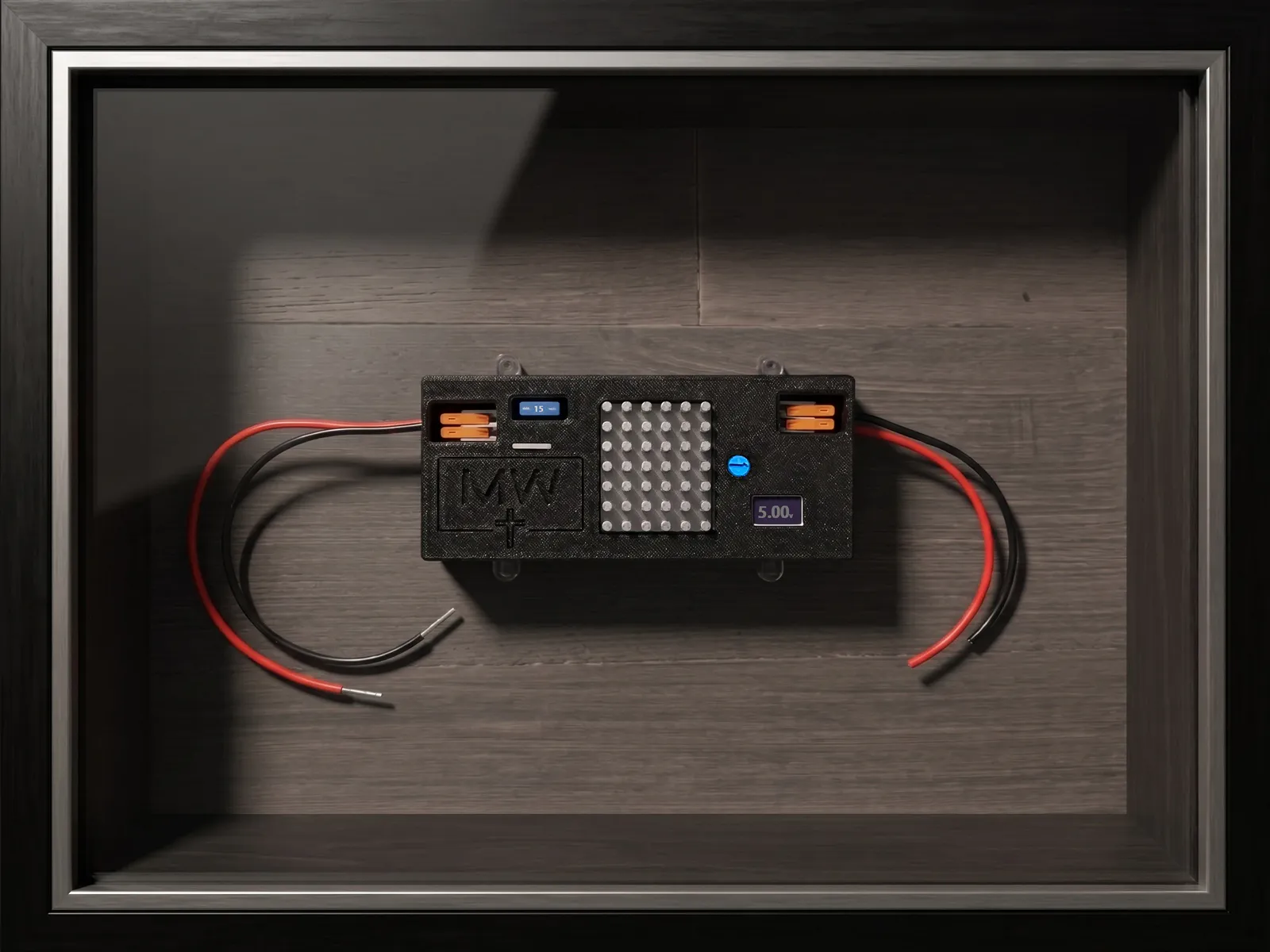
Steps up or down.
The output holds its setting whether the source is above, below or equal to it, so a falling battery, a solar charger's 24 V output or a solar battery bank does not change the output. Below 24 V input the available power is reduced (about 150 W at 12 V input).
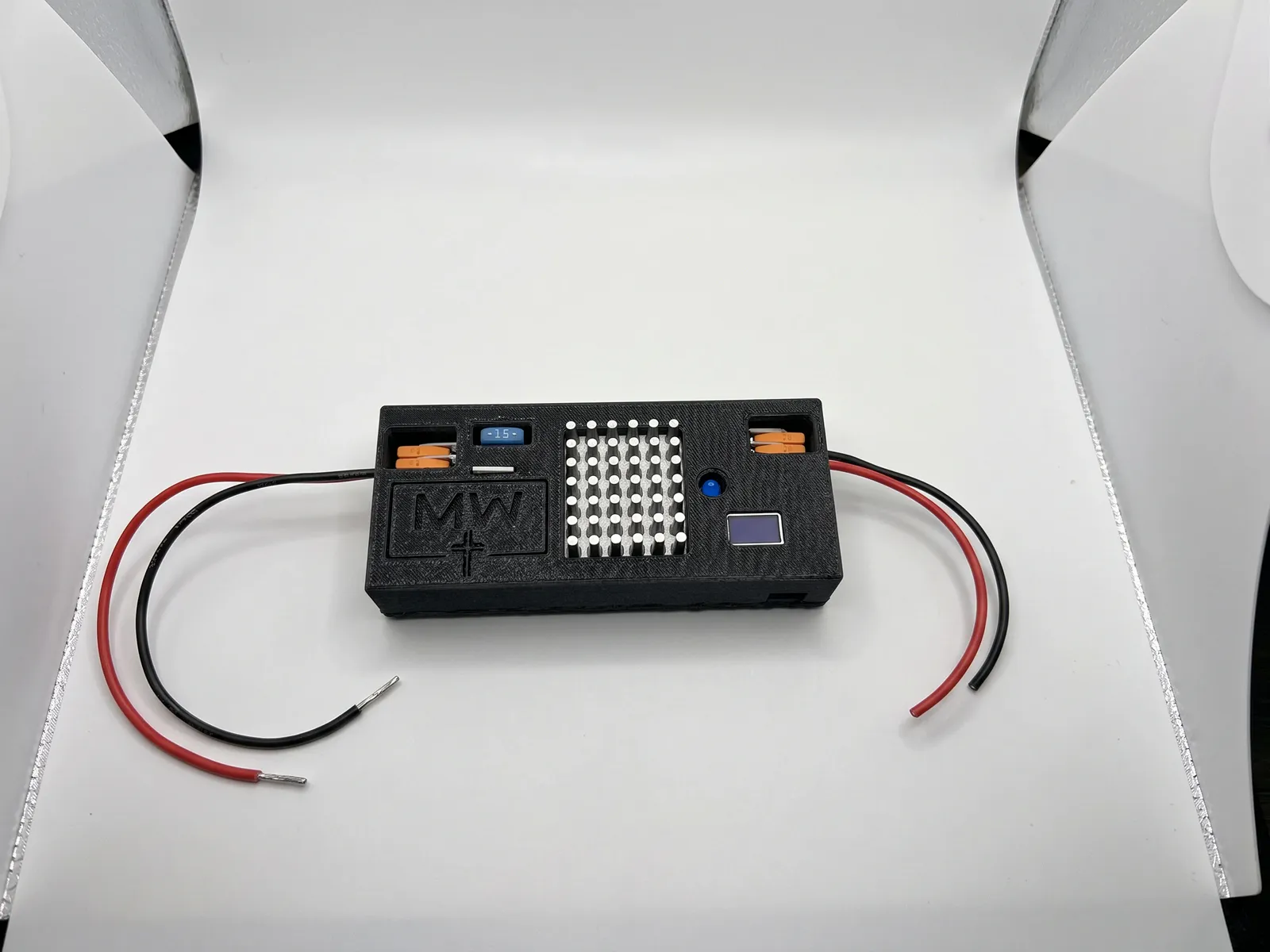
Three bands, fine trim.
Position 1 gives a fixed 5.0 V. Positions 2 and 3 cover 6.1–15.0 V and 15.1–27.6 V, each with a trim control that sets the voltage to better than 0.1 V. The setting is analog, so it is retained through power cycles. The 5 V setting and the lowest part of the 6.1–15 V band are for inputs up to 40 V.
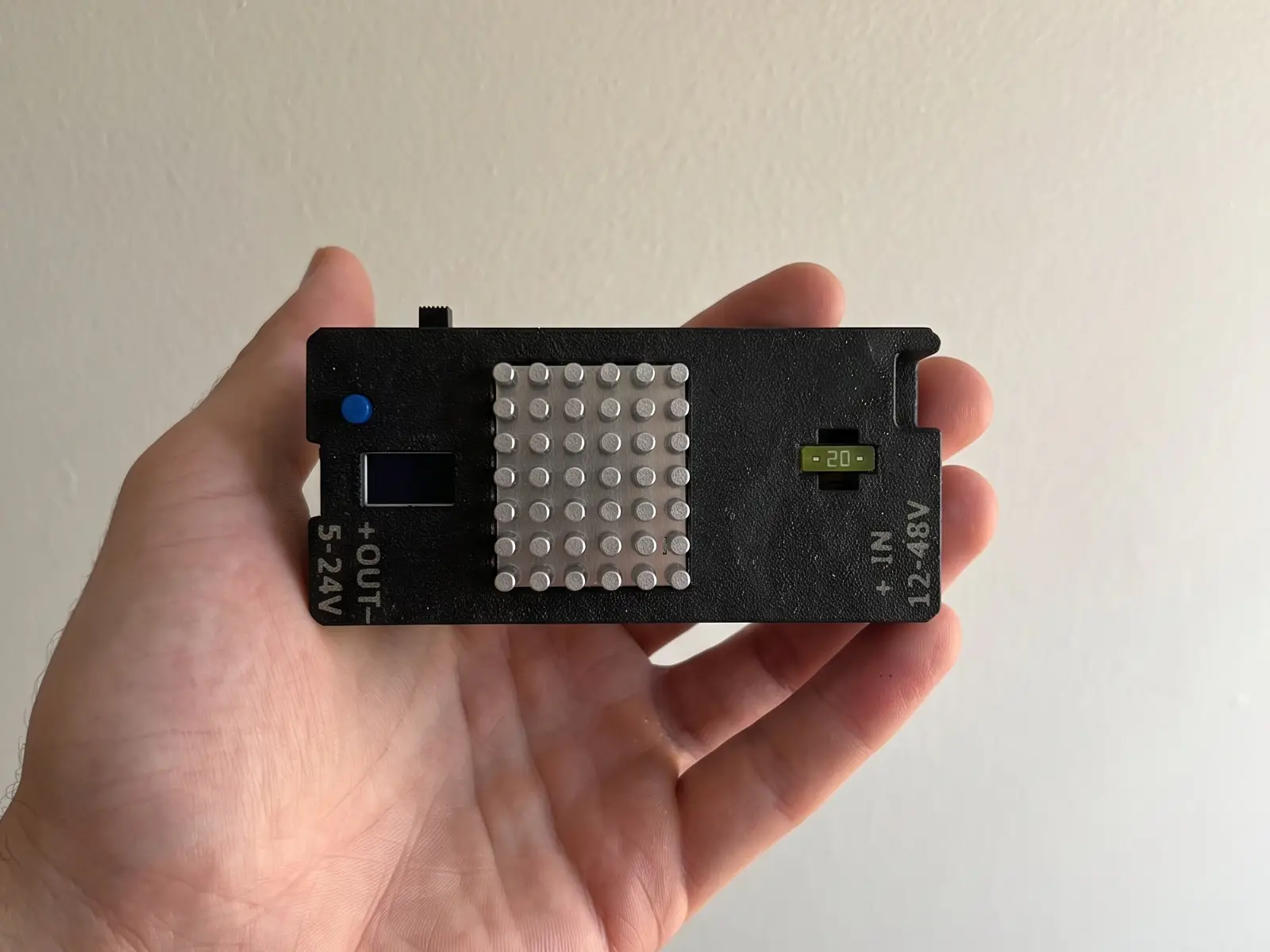
Protected input.
A reverse-polarity blocking MOSFET means a reversed input connection does not conduct. A user-replaceable 20 A MINI blade fuse rated for 58 V DC protects against overcurrent, and a 60 V bidirectional TVS diode across the input absorbs large voltage spikes. The converter itself has over-current, over-temperature and output short-circuit protection with automatic recovery.
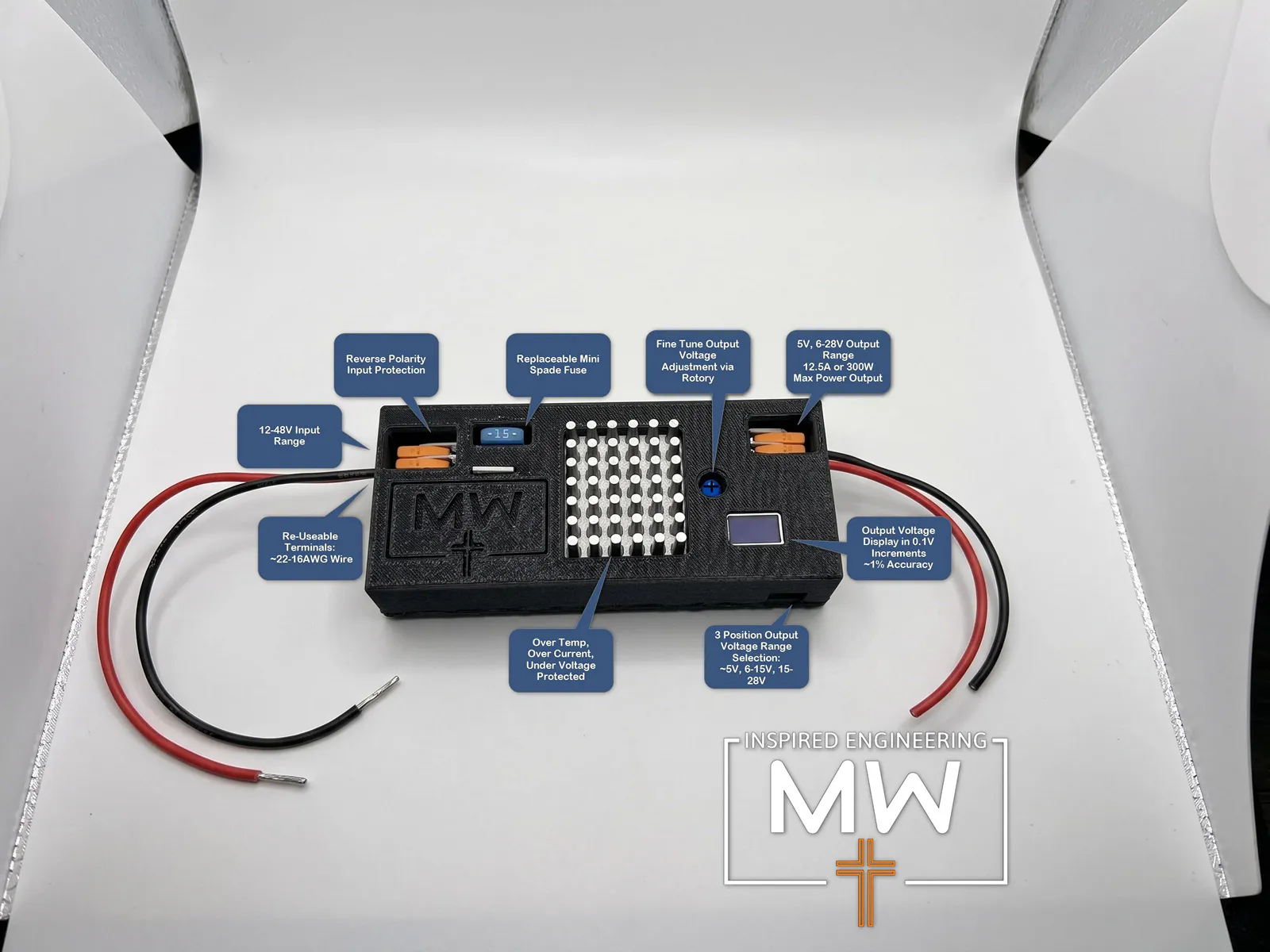
Specifications
9–53 V input · 5 V fixed or 6.1–27.6 V adjustable output · 12.5 A · 300 W from 24 V input
| Topology | Non-isolated 4-switch buck-boost |
|---|---|
| Input voltage | 9–53 V DC (starts at 9.5 V; full specifications from 10 V; 55 V absolute maximum) |
| Output voltage | 5.0 V fixed; 6.1–15.0 V and 15.1–27.6 V adjustable bands |
| Minimum output vs. input | 5 V output available up to 40 V input; above 40 V input the minimum output rises to about 9.6 V at 53 V |
| Output adjustment | 3-position range switch with trim control, resolution better than 0.1 V |
| Maximum output current | 12.5 A |
| Maximum output power | 300 W at 24 V input and above; power-limited below 24 V input (about 150 W at 12 V input) |
| Power and current limits | Independent; whichever is reached first applies. At 27.6 V output, current is limited to about 10.5 A |
| Efficiency | 83–94% measured, depending on operating point |
| Switching frequency | 250 kHz |
| Reverse polarity | Input: reverse-blocking MOSFET, no conduction when reversed. Output: not protected; DC loads only |
| Input transient protection | 60 V bidirectional TVS diode across the input |
| Input fuse | User-replaceable 20 A MINI blade fuse, 58 V DC rated (Littelfuse 0997020.WXN). Replace only with a 58 V-rated MINI fuse |
| Converter protection | Over-current (hiccup), over-temperature shutdown with automatic restart, output short-circuit |
| Load capacitance | Up to about 2,600 µF of capacitance on the load side |
| Display | OLED voltmeter, output voltage, approximately ±1% |
| Cooling | On-board fan over the input stage; converter heatsink fins outside the enclosure |
| Terminals | Push-in spring terminals, input and output. 24–12 AWG; ferrules up to 2.5 mm²; strip 10 mm. At full current: 14 AWG with ferrule or 12 AWG bare stranded |
| Dimensions | Approximately 96 × 45 × 31 mm |
| Board marking | The board is marked 5–28 V, the converter's range; on this version the adjustment reaches 27.6 V |
Applications
| Application | Typical source | Output setting | Notes |
|---|---|---|---|
| Starlink Mini | 12 V vehicle or 24 V battery | 24–27.6 V | A higher supply voltage reduces current and voltage drop on long, thin cable runs. |
| Amateur radio | 12 V vehicle system or 24 V bank | 13.8 V | Holds 13.8 V through alternator swings and battery sag. Suits radios drawing up to about 10 A (QRP HF, VHF/UHF mobiles at reduced power); 100 W HF transceivers draw more than the PFMini supplies. |
| Experimental aircraft and aerial payloads | 12/14 V or 28 V aircraft rails | As the payload requires (5 V or 6.1–27.6 V) | Powers test payloads, aerial survey units and avionics bench setups from aircraft power. Intended for experimental and test use; it is not certified aircraft equipment. Check the aircraft's bus transient limits against the 55 V absolute maximum. |
| Field laptops | 18–40 V tool packs or 24 V vehicle power | 19.5–20 V | Runs laptops directly from DC without an inverter. |
| Portable power stations | Bluetti, EcoFlow or Jackery: 12 V car port, DC barrel port or 12 V RV port | 5 V or 6.1–27.6 V | Turns the station's fixed 12 V DC output into 19–20 V for laptops, 24 V for tools and lights, or 5 V for electronics, without running the inverter. Power is limited by the port, usually 10 A at 12 V (about 120 W). |
| Robotics | 6S–12S LiPo (22.2–44.4 V nominal) | 12 V or 24 V | Powers compute, sensors and servos from the drive battery. Keep the bus under 53 V, including regenerative braking. |
| Overland and off-grid | 12 V, 24 V, 36 V or 48 V battery systems | 12 V | Constant 12 V for heaters, compressor fridges and pumps as the battery discharges. Input must stay at or below 53 V, including while charging. A 48 V system qualifies only below 53 V: not while charging, and not from a fully charged lithium pack. From 48 V systems, outputs below about 8 V are not available. |
Example inputs
Any DC source from 9 to 53 V. It starts at 9.5 V and meets full specifications from 10 V. Buck-boost means the input can sit above, below, or right on top of your output, and the output stays where you set it.
- 12V vehicles, RVs and trailers. A "12V" system swings from under 11V while cranking to over 14V while charging. Set 12V out and it stays at 12V. From 12V input, about 150W is available.
- 24V trucks, buses, boats and heavy equipment. Run 12V gear off a 24V system without tapping half the battery bank. Full 300W from 24V input.
- Drone and RC LiPo packs, 4S to 12S. Power ground stations, payloads and chargers from the packs already in the case.
- Power tool batteries, 18V to 40V. With a battery adapter, the packs on the job site become a field power supply.
- E-bike and scooter packs, 24V and 36V. A charged 36V spare is a 300W supply you can carry.
- LiFePO4 banks, 12V, 24V and 36V. Overland rigs and solar storage.
- Portable power stations (Bluetti, EcoFlow, Jackery). From the 12V car port, a DC barrel port or a 12V RV port. Those ports put out a fixed 12V, usually limited to 10A (about 120W); the PFMini turns it into 19-20V for a laptop, 24V for tools, or 5V, without running the inverter.
- Lead-acid and AGM banks, 12V to 36V. Golf carts, floor machines, backup systems.
- Robot and AGV packs, 24V and 36V. Accessory power straight off the drive battery.
- Laptop power bricks, 19-20V. The spare in the drawer becomes a 5V, 12V or 24V supply, up to the brick's wattage.
- USB-C PD at 20V. Through a PD trigger lead, a 100W USB-C charger or power bank feeds the PFMini.
- Server and DIN-rail supplies. A 24V DIN-rail supply or a surplus 12V server supply becomes any rail from 5 to 27.6V.
- Bench supplies. Most top out at 3 to 5A. Feed the PFMini from a 24V or higher fixed supply and get up to 12.5A at the voltage you actually need.
Mind the peak. Size it to the highest voltage your source ever reaches, charging included, not the number on the label. 53V is the rated maximum; 55V is the absolute limit.
Example payloads
5V fixed or 6.1 to 27.6V out, up to 12.5A, and 300W from 24V input. Enough to run real equipment, not just charge a phone.
- 12V fridges, coolers and Peltier boxes. Off a 24V truck, a 36V pack, or a 12V battery that is sagging.
- 12V diesel heaters on 24V trucks. No second battery, no half-bank tap.
- Laptops at 19-20V. Straight off a vehicle or battery. No inverter, no second conversion, no wasted heat.
- 24V pumps, fans, blowers and actuators. Run them off a 12V vehicle. The boost is built in, up to about 150W from 12V input.
- VHF/UHF mobile radios at 13.8V. Steady while the vehicle bus moves around underneath, for radios drawing up to about 10A.
- Satellite and cellular terminals. Starlink Mini, LTE routers and field network gear on one supply.
- 24V passive PoE radios and network gear. Point-to-point links and remote cameras off a 12V battery.
- Cameras, gimbals and sensors. Bench-test a payload at its real voltage and real current before it goes into the field.
- Single-board computers and edge AI. Raspberry Pi stacks at 5V, NVIDIA Jetson and other edge computers at their own rail.
- LED lighting. 12V and 24V strips, work lights and light bars, at full brightness even as the battery runs down.
- Hobby chargers. Many DC chargers want 24V for full output. Boost a 12V truck to 24V (about 150W available), or run them at full power from a 24V or higher source.
- Soldering irons and field tools. 12-24V irons and tools off whatever battery is in the truck.
- Motor drivers and servos. 6.1-8.4V high-voltage servo rails from packs up to 40V, and 12V or 24V motor drivers for robotics.
- Small 3D printers and CNC controllers. 12V and 24V machines under 300W, from a 24V or higher source.
- Astrophotography rigs. Mount, cooled camera and dew heaters on one steady 12V.
- Prototypes on the bench. Whatever rail the build needs, with up to 300W behind it from a 24V or higher supply, instead of the 3 to 5A most bench supplies stop at.
Real world uses
Got a PFMini working on something? Send a photo to contact@maniwrks.com.
Where to buy
Direct from ManiWrks for a discount, or through the marketplace you already buy from. Same unit either way.
$299.00 USD Plus applicable tax, shipping and handling. Taking orders now!
Ships to the US and Canada. Unused units can be returned within 14 days of delivery. Shipping & Returns
Marketplace listings are not live yet. Both links above are placeholders.
Performance notice
The PFMini works across a very wide range of input and output conditions, and its output ripple, transient response and operating temperature can vary considerably from one installation to another. Published figures were measured by ManiWrks under the conditions stated with each figure. Confirm performance in your own application before relying on it, particularly at high power, at low input voltage, or in a confined or warm location. During initial use, monitor the unit's temperature at full load; if it runs hot, reduce the load or improve airflow. ManiWrks can help with application questions.
Operating notice
The PFMini is a non-isolated DC-DC converter for technically qualified users. Operate it within the published input voltage (9–53 V, 55 V absolute maximum), output current and power limits. The output is not protected against reverse connection or back-feeding from another source; connect DC loads only. Replace the input fuse only with a 20 A, 58 V-rated MINI blade fuse. The user is responsible for wiring, fusing and the suitability of the installation for its application. Manifold Industries LLC accepts no liability for damage to the PFMini after delivery or for connected equipment. Use with caution and at your own risk.
The rest of the line
PFMini is the single-channel unit. The PFLite and PFMax are the aviation payload power systems built on the same converter core.
PFLite: 30A, dual input with microsecond failover, two adjustable
channels. In production at $5,000.
PFMax: 40A, soft latch, priority input selection, LCD telemetry,
onboard battery. In V0.3 testing.